
Arizona Survivors of Communism Warn Voters of a Socialist Takeover

Summary: Arizona EZAZ members Manuela Callini and Captain Onofre Gutierrez joined other survivors of communism on The Jenny Beth Show to respond to the Democratic Socialists of America's 2026 program, which asks readers to imagine a day without capitalism. Panelists from Romania, Nicaragua, China, the Soviet Union, and Hungary compared those promises to the shortages, assigned jobs, bribery, and loss of freedom they lived through. They urged Arizona voters to read the DSA program and decide for themselves.

ARIZONA — Arizona members of EZAZ, Manuela Callini and Captain Onofre Gutierrez, joined other survivors of communist and socialist systems on The Jenny Beth Show to respond to language from the Democratic Socialists of America's 2026 program.
The program invites readers to "imagine taking a day off from work in the future without capitalism." It describes a society with no bills, no debt, no mortgage, no landlord, no need for health insurance, and publicly funded retirement, food, education, energy, medicine, and transportation treated as common goods rather than for-profit businesses.
Callini and Gutierrez, both Arizona residents and survivors of communism, warned that these promises echo systems they lived under. Their comments, along with those of the other panelists, offer firsthand accounts of what similar language produced in practice.
What the Survivors Said
Captain Onofre Gutierrez, who left Nicaragua, said the idea of "taking a day off from work" without capitalism does not make practical sense. Without factories and companies, he explained, there is nowhere to work. He called capitalism "the machine that drives this country" and noted that even groups promoting alternatives still rely on it.
He described Nicaragua's path: decades under the Somoza dictatorship followed by 47 years under the Sandinistas. In that span, he said, the country "has not seen one day of what freedom is." The pattern he identified is successive regimes that promised change but delivered prolonged authoritarian control with no period of genuine freedom in between. He stated that he sees and fears the same pattern developing in the United States as socialist ideas gain influence within the Democratic Party.
Manuela Callini, who lived under Romanian communism until the fall of Nicolae Ceaușescu, pictured a dark, gray, hopeless day. Private property and businesses would be taken, she said, in exchange for promises of safety and abundance.
She noted that the government controlled job assignment, housing, and pay. Ordinary people developed informal trading networks, sometimes using factory preserves as currency, because the formal system did not reliably supply necessities such as toothpaste.
Romanian engineer Ovidiu Frusina, who lived in Romania for 23 years, described what a typical work week looked like under that system: limited or no hot water, overcrowded public transportation, the need to bribe supervisors, long lines for basic goods such as bread, and days spent playing chess or backgammon when Party approvals limited real production. He also described government-assigned jobs after university with little choice of location or type of work, equalized pay, and multi-year waits for cars of poor quality.
Other panelists made related points. Sasha Gong, who experienced the aftermath of China's 1958 collectivization as a young child, said the DSA language read like a translation of Mao's policies that preceded the famine in which tens of millions died. Soviet physicist Yuri Yarim-Agaev described the vision as equivalent to 100 percent taxation and full state control of distribution. Agnes Gibboney, who survived communism in Hungary, also joined the panel.
The panelists distinguished between different forms of socialism and stressed that totalitarian systems concentrate power and eliminate political and economic alternatives.
The DSA Language and Historical Context
The Democratic Socialists of America program presents the "day without capitalism" as an aspirational alternative in which people control their own labor, housing is treated as a human right, and essential goods are removed from the for-profit sector. Proponents argue this can be achieved through democratic institutions and differs from the one-party dictatorships of the 20th century.
Critics, including the survivors on the panel, point to earlier attempts to eliminate private enterprise, debt, landlords, and profit in core sectors. Those efforts produced shortages, assigned work, informal bribery economies, and the erosion of personal choice.
These are factual descriptions of the DSA text and the lived accounts. Readers can review the full DSA program and the full episode or transcript for complete context.
Arizona Context and Policy Comparison
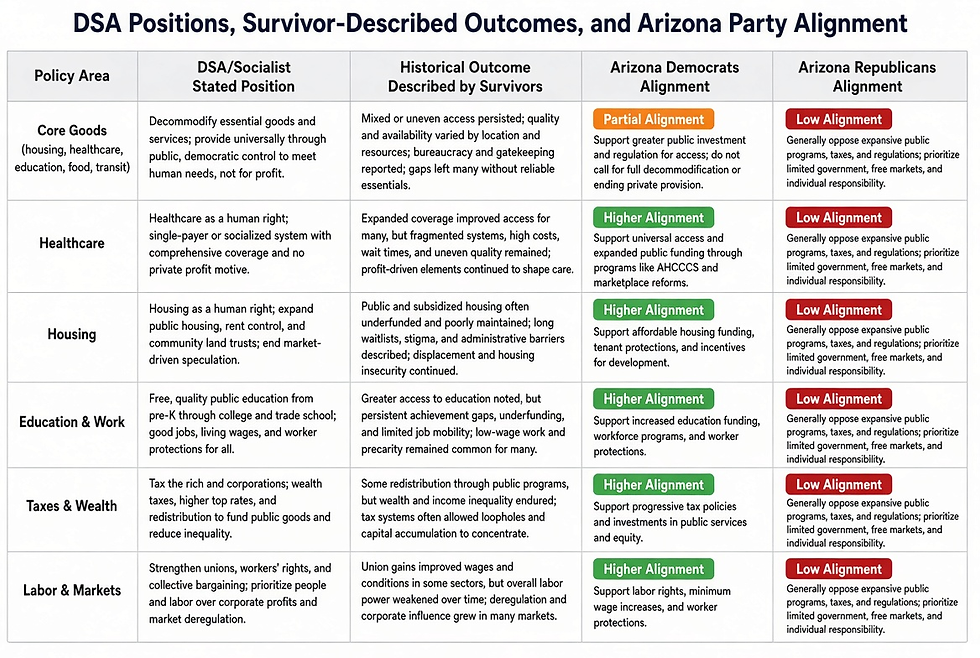
The Democratic Socialists of America has active chapters in the Phoenix metro area and Tucson, and has endorsed candidates in Arizona. Readers can see the chapters' endorsements on their own websites: Phoenix DSA Voter Guide and Tucson DSA Endorsements.
Arizona's Democratic Party platform (including the 2020 version supporting Medicare for All) and candidates overall span a range of views. Not every Democrat is aligned with the DSA, and Republican elected officials generally oppose its program.
The following graphic compares DSA/socialist stated positions, the historical outcomes described by the survivors, and the documented alignment of Arizona Democratic and Republican positions:
Civic Education Takeaway
Arizona residents can evaluate these ideas by reading primary sources: the DSA program language, the survivors' full statements in the Jenny Beth Show series, candidate websites, DSA chapter materials, and the voting records or proposed legislation of current officeholders.
Arizona's Request to Speak system allows citizens to comment on bills at the state legislature. Local city council meetings in Tucson, Tempe, Scottsdale, and other jurisdictions are open for public input.
Voters can compare the historical outcomes described by survivors from Romania, Nicaragua, China, the Soviet Union, and Hungary with the policy proposals being advanced today and decide for themselves which approaches best match their priorities for Arizona's economy, housing, education, and individual liberty.
This overview is intended solely for civic education. It does not endorse or oppose any candidate, party, or organization.
________
EZCivics.org is funded by our readers. If you found this news brief educational, consider chipping in to fuel our work by going HERE.


