top of page

All Briefs


Summary: Stealth Analytics found the cost of living first among likely Arizona voters at 42% — and first in every party: Democrats 57%, Republicans 39%, independents 34%. Other surveys found high costs are a top issue. This brief explains how state government reaches a grocery bill, a rent payment, and a power bill — and how AZ Wallet Watch records those floor votes so voters can stay informed on how their representatives helped lower costs or made things more expensive. It does not support or oppose any candidate or party.


ARIZONA — Cost of living is the top issue for Democrats, Republicans, and independents. AZ Wallet Watch now keeps a public record of the state votes that move those costs. Citizen researchers read 397 enrolled floor bills from 2023 through 2026 and scored them by how they impact everyday costs and economic opportunitie.


How State Government Hits a Household Bill

A grocery receipt is not only a Washington story. A republic splits power on purpose. No one office sets the price of milk. Each level of government writes a different line on the receipt.


The Legislature. A bill needs a majority in the House and the Senate to reach the Governor's desk. Statutes may cover state taxes, insurance rules, housing law, occupational licenses, and spending. Spending today is a tax tomorrow. Bills that give “handouts” to one group or another still belong on a cost ledger because it increases government spending.


The Governor. After both chambers pass a bill, the Governor signs it, vetoes it, or lets it become law. A veto can stop a cost from being added, or stop a cost from being cut. The sign-or-veto is the governor’s recorded vote.


Cities and towns. Local councils levy their own sales taxes. In Arizona, many still tax food for home consumption. Two carts in two cities can be taxed at different rates because two councils voted differently.


The Corporation Commission. Many electric and gas rates do not go through the Legislature. They go through this separately elected body. That is why a power bill can move even when the House is out of session.


Housing. State statute sits on top. City zoning and permitting sit underneath. If fewer homes can be built, rents and starter-home prices rise. Each level of government involvement increases costs.


When the Legislature refers a measure, voters act as lawmakers. That is initiative and referendum — the people’s statute book.


The Scorecard Identifies 4 Kinds of Wallet Bills

Each bill goes into one of four buckets.


Cuts Costs. The bill lowers what people pay — a tax cut, a fee cut, or a rule that makes a basic good cheaper.


Raises Costs. The bill makes life more expensive, shrinks opportunity, or grows government in a way households eventually fund.


Get Ahead. The bill expands the chance to earn, work, build, or keep more of what you make.


Stops Waste. The bill trims a regulatory burden or a spending habit that does not have to be there.


AZ Wallet Watch scores the whole bill vehicle, not a talking point from a speech or a bill title.


How an Elected Official Earns Scorecard Points

Every bill that matches one of those four categories is worth 1 point. A legislator earns the point with a Yes vote on a Cuts Costs, Get Ahead, or Stops Waste bill. A legislator earns the point with a No vote on a Raises Costs bill. Bills that died on the floor still count. Bills the Governor vetoed still count. The Governor is scored on sign or veto only.


An elected official with a cumulative score of 80% or higher receives the site’s green Fights High Costs shield. An elected official with a score below 80% receives the site’s red Enables High Costs shield.


  • Caucus averages in the file: Republicans 89.1 percent, Democrats 39.3 percent. That is a roll-up of individual floor votes, not an endorsement. Full scores: azwalletwatch.com.

  • Governor scoring is different from legislator scoring. Legislators are scored on floor votes. The governor is scored only on sign or veto. On the cost-cutter bills that reached Gov. Katie Hobbs’s desk, 48 percent were vetoed. (That is a description of the official act, not an endorsement or opposition.) Full Breakdown: azwalletwatch.com


Not Voting is excused only if the member was excused that day, or cast no other yea or nay that day. If the member voted on other bills that same day, a skipped vote counts against that member’s score.


How to Use It

The homepage is built to be simple, so you don't need to know your district number.


  • Type your Arizona address.


  • The site pulls the officials who represent that address and shows each person’s cumulative score, plus the shield that score earns.


You can also dig deeper and look through every bill, read how it impacts costs, and contact elected officials currently in office.


Why cost-of-living votes are being scored

Stealth Analytics surveyed 530 likely November 2026 voters from August 11–13, 2026 (±4.3%, SMS-to-web). Cost of living and inflation led at 42% — three times immigration (14%) and three times water (14%). No other issue reached 15%.


Cost of living ranked first among Democrats (57%), Republicans (39%), and independents (34%). That is the only issue with standing in every coalition.


AARP Arizona found rising prices the most-cited top-two issue at 37%, with groceries first. The League of Arizona Cities and Towns found housing the top local worry at 44%. UnidosUS found 56% of Arizona Latino voters naming food, housing, gas, and electric bills first.  A Grand Canyon Institute survey found 69% rating the state’s cost of living only fair or poor across all three party groups.


Phoenix-area prices have climbed about 31% since 2020.


Common Sense Institute estimates a typical Valley household now spends nearly $6,900 a month on everyday costs — about $1,700 more than before the pandemic.


The same Stealth survey described Proposition 316, which would cap local grocery taxes at 2% and require voter approval to raise them. After a neutral description and balanced arguments, 60% supported it, 9% opposed it, and 31% were unsure.


That poll shows a policy result, not a recomm endation on how to mark a ballot.


The polls say Arizona already knows the problem. The scorecard is there so the process is not a mystery.


________


EZcivics.org is funded by our readers. If you found this news brief educational, consider chipping in to fuel our work by going HERE.


________


This brief is to educate on public polling and on how government is structured. It does not support or oppose any candidate or political party.

Arizona tools: How to Vote → https://www.azvote.org/



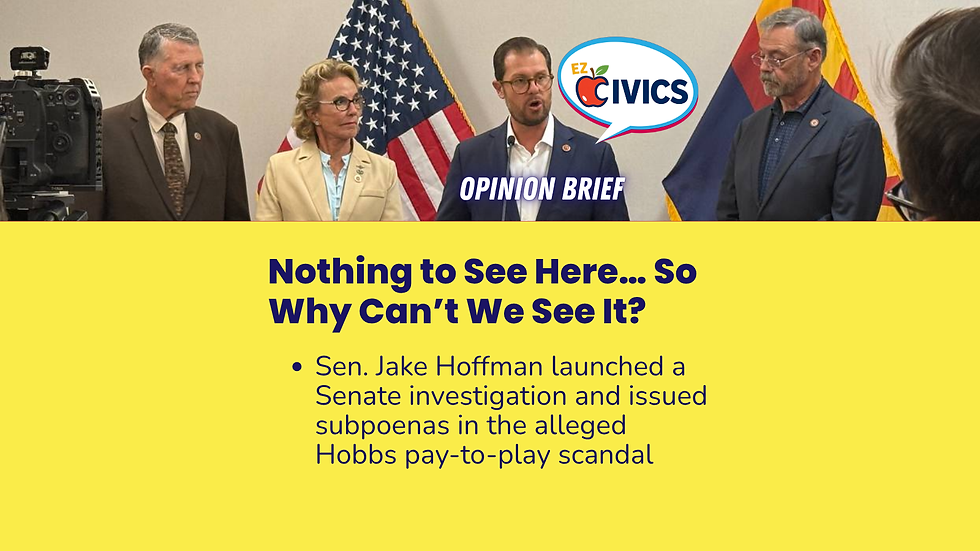
OPINION — Today, Senator Jake Hoffman stood up for Arizonans and demanded something that apparently takes a whole lot of courage these days: transparency and accountability in the alleged Hobbs pay-to-play scandal.


Instead of applauding the effort, mainstream media hammered him about his motives, the election, whether another investigation was necessary, whether taxpayer money should be spent on it, etc. My thoughts were - NOW we’re suddenly worried about taxpayer money?


Well, how about the millions of taxpayer dollars that were spent on preferential rate increases? Why wasn’t the media worried about that?


A few weeks ago, I knocked on doors to learn what voters of all political backgrounds cared about. I heard the same thing: people want accountability for corruption.


Today, when Sen. Hoffman announced the Senate’s investigation and their subpoenas, reporters questioned the timing, suggesting that doing so before an election made it political. 


But I say the opposite: refusing to investigate because an election is approaching is exactly what would make it political. AG Mayes closed an investigation without releasing the files to the public, right before an election in which they are both running. Maybe that’s somewhat political, especially when you have one state executive investigating another who happens to be from the same political party, with both up for re-election.


Senator Hoffman’s common-sense investigation definitely upset the establishment. As a private citizen, I support Sen. Hoffman in the Senate’s pursuit of truth, and I congratulate him for his courage and for standing in front of a room full of reporters who did nothing but attack him with dozens of adversarial questions.


Transparency should not terrify an innocent person. If the evidence clears Governor Hobbs, then it would only be in her favor to show the receipts. 


Thank you, Sen. Hoffman, for not letting this one go and for standing up for your constituents, for transparency, and for our freedoms.


About the Author

Manuela Callini

Manuela Callini is imported from Europe and has officially had it with bureaucracy, government overreach, and complaining about what’s broken.


So she joined the grassroots and made it her mission to boss the government, preserve our freedoms, and leave the world a little better than she found it.


________


EZcivics.org is funded by our readers. If you found this news brief educational, consider chipping in to fuel our work by going HERE.

Summary: The power of a majority is a core mechanism of American government—shaping laws, agendas, and leadership at every level—but only when citizens engage and use it to influence outcomes. When voters understand how different majorities work and vote the full ballot, “We the People” truly become the bosses of government.


By Amanda Monize, EZAZ.org Grassroots Strategy Director (AKA Grassroots Glow-Up Guru)


CIVICS -

The first three words of the Constitution—“We the People”—are not poetic decoration. They’re a job description.


In America, the people are not meant to be spectators to government. We are supposed to be the bosses. But like any workplace, you have to understand the organizational chart if you want to influence decisions. And one of the most important tools in that chart is something deceptively simple: the majority.


At its most basic, a majority means more than half—50 percent plus one. But depending on where you encounter it in American government, a majority can do very different things. It can pass laws, set agendas, shape policy, and sometimes decide who holds power for years to come. Understanding where majorities matter—and where they don’t—is one of the most practical lessons any citizen can learn.


America Is Not a Pure Democracy

The United States was designed as a constitutional republic, not a pure democracy. The Founders feared raw majority rule could become unstable or even oppressive if it trampled minority rights. So they built guardrails.


Take the presidency: Americans don’t directly elect the president by national popular vote. Instead, the Electoral College requires a majority of electoral votes. This design ensures smaller states keep a meaningful voice—balancing nationwide majority rule with regional fairness.


Whether one loves or dislikes that system, it’s a crucial civics lesson: not every majority in government works the same way.


When the People Vote Directly

At the same time, there are places where majority means pure people power. Many states let citizens vote directly on ballot propositions or initiatives. When a majority of voters back a measure, it becomes law—instantly. No committee, no backroom deal, just the people deciding for themselves.


These direct votes have shaped everything from tax policy and water projects to education reform. They are the clearest example of citizens not asking government to act—but acting themselves.


The Majority That Runs the Legislature

Perhaps the most powerful majority in American politics, though, lives inside state capitols and Congress.


In any legislature, the majority doesn’t just win votes; it writes the script. It sets the agenda, selects committee chairs, decides which bills get hearings, and which never see daylight. Political insiders like to joke that the most powerful phrase in politics is not “I agree” but “the chair recognizes…” because whoever controls the majority controls the microphone.


A one-seat difference can reshape the entire direction of government. In 2001, when a single U.S. senator switched parties, the Senate majority flipped overnight—and with it, leadership of every committee and the national agenda itself. That’s how much majorities matter.


Governors, Leverage, and the Art of Governing

Majorities also define a governor’s strength. When the governor’s party holds the legislature, policy tends to move quickly. When it doesn’t, every bill becomes a negotiation. Legislatures can pass measures a governor dislikes; governors can veto them. Some legislatures can even override those vetoes—with a supermajority.


To outsiders, it looks like gridlock. In truth, it’s balance—different majorities jockeying for influence, just as the Founders intended.


Image created with the help of AI


Why “Voting the Whole Ballot” Matters

Here’s where all of this meets real life: majorities start at the ballot box. Voters tend to focus on the top races—president, governor, senator. But the down-ballot contests often determine who holds the working majorities that actually steer government.


State legislators, county supervisors, school boards, and judges collectively decide how your community operates—taxes, education, water policy, even how elections run. Every line on that ballot is a lever of power. When citizens skip local races, they hand those levers to someone else.


If you want the political machinery to move in your direction, you have to vote your whole ballot.


Arizona’s Ballot Power: The People Decide

Arizona gives citizens even more opportunities to exercise majority power directly. 


In addition to electing lawmakers, voters themselves can decide major policy questions at the ballot box. The legislature can refer measures to voters through a House Concurrent Resolution (HCR) or Senate Concurrent Resolution (SCR), asking the public to approve proposed constitutional changes or statewide policies. 


Citizens can also bring their own ideas forward through Arizona’s initiative and referendum process by gathering signatures and placing measures on the ballot. In other words, in Arizona, “We the People” are not just choosing leaders—we can write the rules ourselves. 


There is one important exception worth noting: after voters approved Proposition 132 in 2022, any ballot measure that raises state taxes must now receive a 60 percent supermajority to pass rather than a simple majority. It’s one more reminder that the rules around majorities matter—and that citizens who understand those rules are far better equipped to use them.


The Happy Warrior Citizen

The good news? The American system was built so that ordinary citizens can learn it. You don’t need a law degree to understand majorities—you just need curiosity, participation, and persistence.


Majorities pass laws. Majorities set agendas. Majorities choose leaders. And voters choose the people who create those majorities.


That brings us back to those three opening words: We the People. They aren’t ceremonial. They’re a call to action. The ultimate majority in this country doesn’t sit in a chamber or caucus—it lives among the citizens who show up and engage.


When we understand how our government works—and vote accordingly—we become exactly what the Constitution intended: not subjects of government, but its bosses.


About the Author: Amanda Monize, Grassroots Strategy Director at EZAZ.org, is a former teacher and Science Instructional Specialist. She joined EZAZ as an Arizona citizen seeking to understand local government, later volunteering in statewide grassroots campaigns and running for office. She designed and led civic education trainings across Arizona and serves as an elected official. Now leading EZAZ initiatives, she empowers citizens through organizing, education, and advocacy—believing an informed, active citizenry secures liberty.

________

EZcivics.org is funded by our readers. If you found this news brief educational, consider chipping in to fuel our work by going HERE.

Stay in Touch!

As the saying goes, an apple a day keeps the commies away. Sign up to stay informed about how government works and become an engaged citizen to help keep the Republic. 🍎

AI is used to assist in the content creation of this site.


© 2026 Strong Communities Foundation of Arizona Inc. All Rights Reserved. Any mention of political candidates is not an endorsement. All events are private and off the record. Media is not allowed. Affiliated with Strong Communities Action. Other affiliated websites include: EZAZ.org, matchyourvalues.org, azinflationrelief.com


By providing your information to Strong Communities Action and Strong Communities Foundation of Arizona, you agree to receive email updates and text messages from SCF and its partners in freedom. We do not sell your data. DONATIONS MAY BE TAX-DEDUCTIBLE UNLESS OTHERWISE STATED. THANK YOU FOR YOUR SUPPORT! Privacy Policy. Email learn@ezcivics.org with questions.

bottom of page